
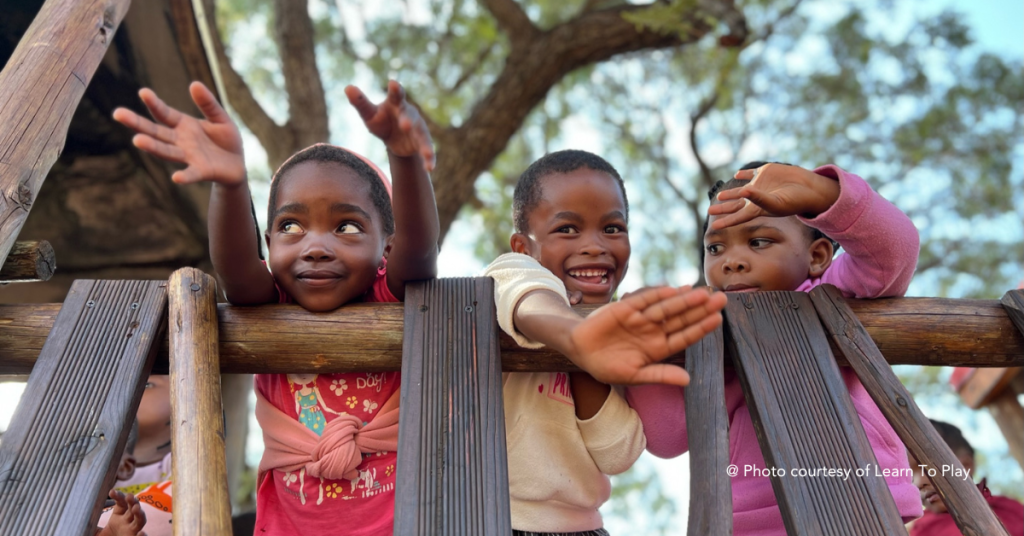
Blog by Priyanka Handa Ram, Co-founder and Chief Energy Officer of Learn to Play
June 11, 2025 – Few ideas are as universally accepted—and as consistently under-prioritised—as play.
This year’s International Day of Play (June 11) asks us to do something deceptively simple: Choose Play—Every Day. At Learn To Play, it’s a call that echoes much of what we already practise. Play is one of the most effective and accessible interventions we have to support children’s development, especially in the early years.
When we talk about play, we’re not referring to a prescribed set of activities or colourful classroom corners. We’re referring to a way of engaging with children that strengthens cognitive, social, emotional, and physical development—often simultaneously. When that kind of play happens consistently, it shapes the trajectory of a child’s learning and well-being in measurable ways.
Practical Barriers to Play
In many of the communities where Learn to Play works, the barriers to daily play are not philosophical—they’re practical. Time poverty, lack of resources, overstretched caregivers. But these constraints make the case for play stronger, not weaker. When caregivers are supported to value play—and to see it as something they can facilitate using what they already have—the dynamic begins to shift.
Our approach is not to import a model, but to build one from within. We aim to build a model that reflects the rhythms, languages, and realities of the communities themselves.
Botswana is widely seen as a stable, diamond-rich, middle-income country—not one in urgent need of early childhood intervention. But in Botswana’s most marginalised areas, play often falls behind more immediate needs.
In these areas, early pregnancy, malnutrition, and generational trauma are part of daily life, and caregivers—often teenage mothers or grandmothers—raise children without access to mental health services, preschools, or safe spaces to simply be. Children face toxic stress, which affects their emotional and physical development.
Removing the Barriers to Play
To make play more accessible, Learn To Play brings early learning into every day through simple, scalable programmes that don’t rely on expensive infrastructure. Our Parent Playbox equips caregivers with low-cost activities they can do at home—transforming routines into moments of connection and learning. Our Playgroups, led by trained Maatla Mamas, offer nurturing spaces where children can play, grow, and feel safe. These leaders are not outsiders; they are from the community, bringing trust, language, and cultural fluency to every session.

Everyday Play, Everyday Change
In the Dukwi refugee camp, one caregiver’s journey captures how daily play can transform both children and adults. Originally from Congo, she had not grown up with play.
In Congo, my parents didn’t play with me,” she said. “We just knew our role—to eat, sleep, and not get in trouble.
At first, she saw play as unnecessary. But through weekly group meetings, activities from the Playbox, and encouragement via WhatsApp messages, she began joining in—drawing, making dough, blowing bubbles. Her daughter, once quiet and withdrawn, began to open up. She could now follow instructions, sing, and play with growing confidence.
Now my child can laugh with me,” she said. “Before, she feared me.”
The impact of the Playbox went beyond developmental milestones. It gave this mother new tools to connect, regulate, and parent in ways she had not experienced herself. “I used to scold quickly,” she admitted. “Now, I breathe. I think first. I respond differently.”
This is the kind of change Learn To Play aims to make possible through its community-led, low-resource model: a shift in mindset that allows play to take root in everyday life.
Working With Governments to Embed Play
To expand access to play, we work closely with local councils, ministries, and partners to make play a national priority. In Botswana, we’ve contributed to policy, co-designed pilots with local governments and communities, and brought play into homes.
Our training-of-trainers model ensures that local facilitators and government staff are equipped to scale up play-based approaches in a sustainable way. Our Play-Based Programme Assessment Toolbox (PPAT) helps measure and improve program quality using tools that are contextually relevant.
Rather than working around government systems, we build through them—embedding play into parenting workshops, early learning centres, and community outreach to reach more children, more meaningfully.
Advancing the Right to Play—Together

To uphold play as a right, we must also examine where it is missing—and why. Botswana is often seen as a middle-income success story. But the statistics tell another story: persistent inequality, widespread childhood poverty, and limited access to foundational early development support. This isn’t a contradiction—it’s a misperception. And like many misperceptions in global development, it obscures where support is most needed.
On the ground, the challenges are real and urgent. Learn To Play works in communities grappling with trauma, food insecurity, and a lack of critical services. The positive effects of daily, play-based care in these settings are clear and measurable.
This is why collective action is critical. Networks like ECDAN are not only expanding the reach but also shifting the global lens—helping the world see more clearly and respond more equitably, so that development efforts truly reflect actual needs. Advocacy must narrow the space between perception and lived experience. It must make visible what local communities already know—that the right to play must apply everywhere. Including in Botswana.